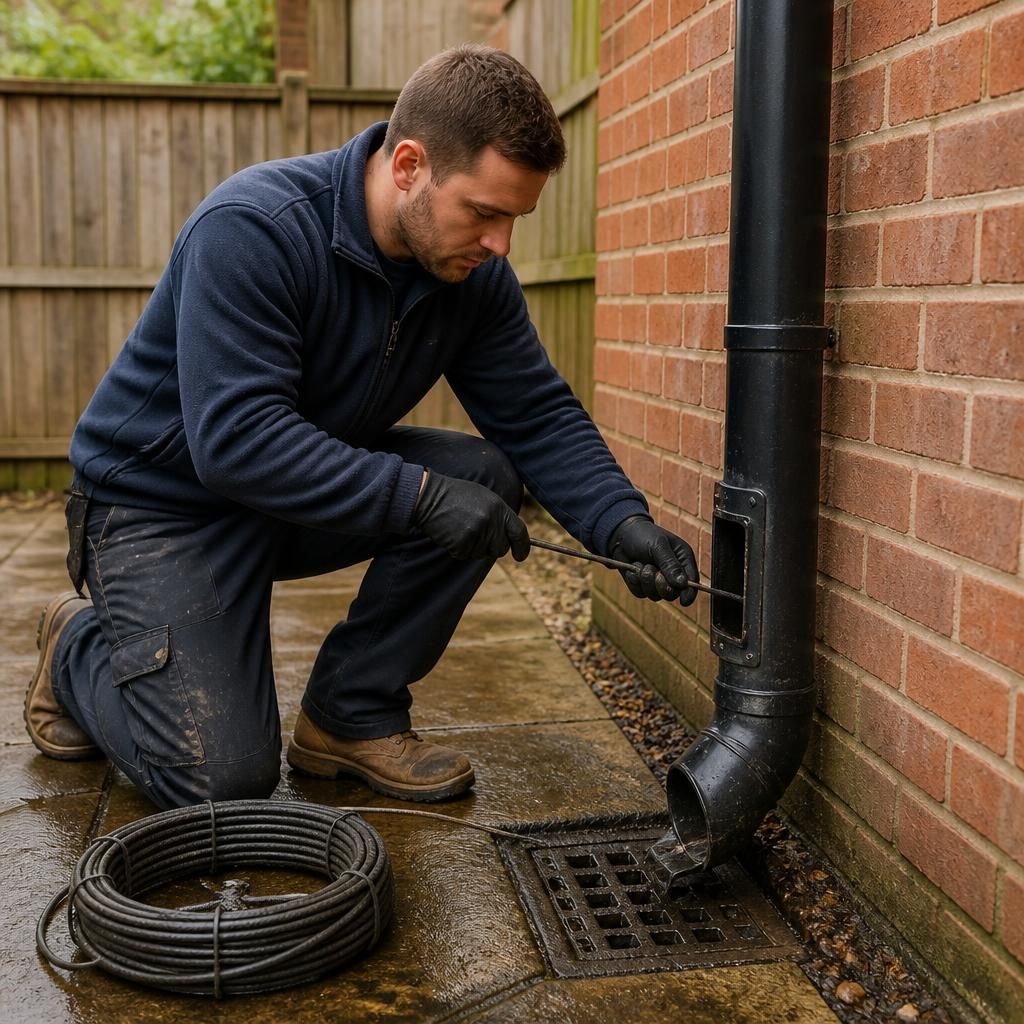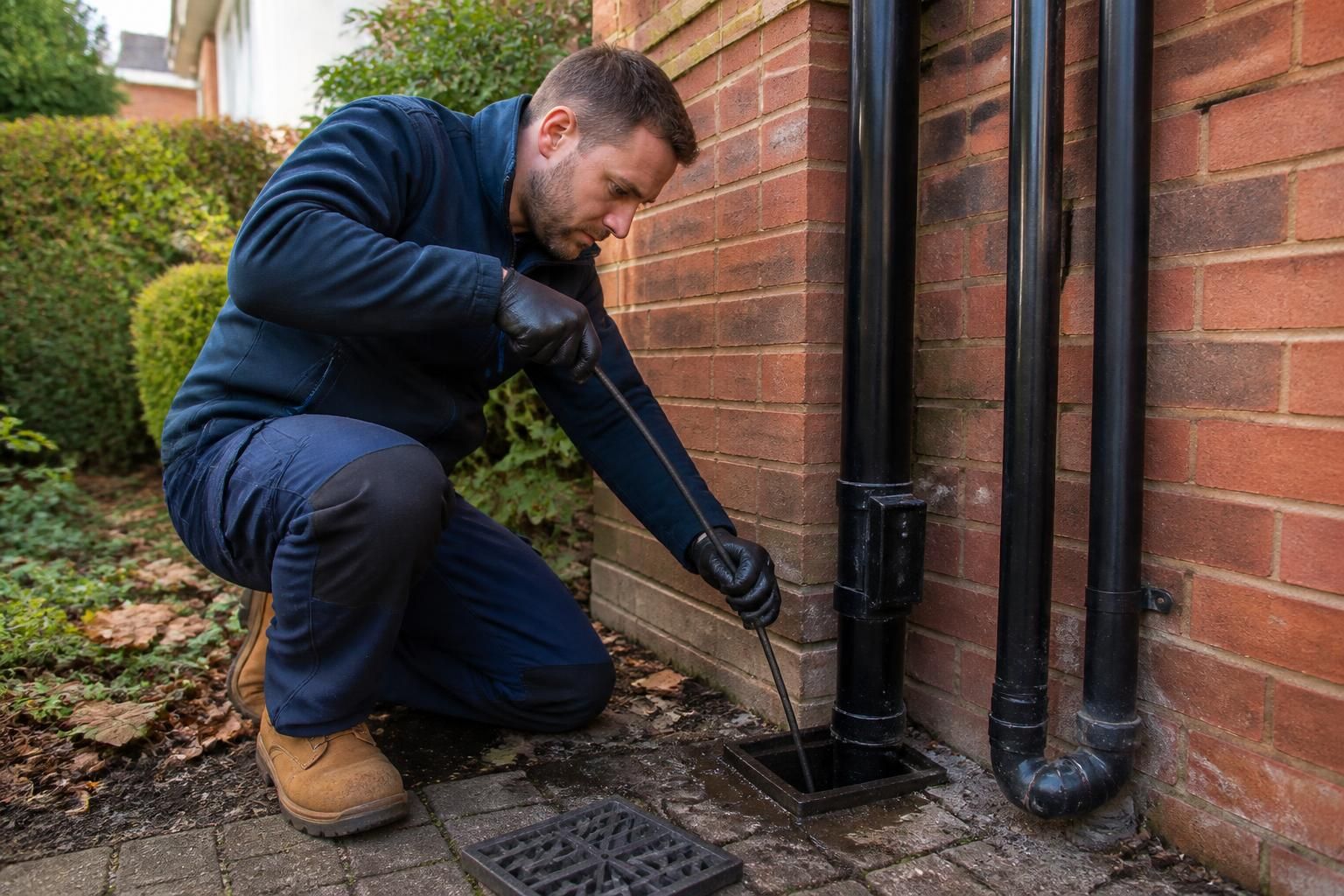
The deciding factor is not simply the height of the downpipe, but whether the obstruction can be reached through a suitable access point and cleared without stressing the pipe or its joints. A ground-level approach is generally appropriate when the blockage is near the outlet, at the bottom bend or within a section that can be accessed safely from the base of the system.
How the blockage is approached
Before attempting to clear the pipe, the route of the downpipe should be checked. Rainwater may be entering through the gutter but failing to exit at the bottom, or it may be escaping from a joint, shoe or connection onto the wall. Looking for damp patches, staining, overflowing joints and displaced fittings helps identify whether the restriction is inside the pipe or at the outlet.
- Check the discharge point: Leaves, silt, moss and soil can collect where the downpipe enters a drain, gully or soakaway connection. Clearing this area may restore flow without work higher up the pipe.
- Use a suitable rod: Flexible drain rods can be introduced from the lowest accessible point and worked carefully through soft debris. The rod should not be forced, twisted excessively or pushed beyond a bend where it could become lodged.
- Flush progressively: A controlled flow of water can help move loosened material towards the outlet. Water should be introduced gradually rather than at full pressure, particularly where joints are old or the pipe is made from brittle material.
- Inspect removable sections: Some systems have a detachable shoe, access fitting or lower section that can be removed from ground level. Taking off the appropriate section can provide a clearer view of the obstruction and reduce the risk of pushing debris further into the drainage system.
Where the blockage is made up of compacted mud, nesting material or a mixture of leaves and grit, repeated flushing may only move the material temporarily. A professional may use inspection equipment to establish its position before selecting a suitable clearance method. This is particularly useful where the downpipe disappears into the ground, because the restriction may be in the underground drain rather than the vertical pipe.
What can make ground-level unblocking unsuitable?
Access from the base may not be effective if the obstruction is high in the pipe, firmly wedged at a bend, or located behind a concealed section. It is also less suitable where the pipe has sagged, split, pulled away from the wall or become disconnected. In these cases, clearing the debris alone will not correct the underlying fault and water may continue to discharge against the building.
Care is needed with older plastic, cast-iron and clay drainage components. Excessive pressure can separate push-fit joints, crack fragile sections or force water into the wall. A blocked downpipe may also leave standing water in the gutter, adding weight to the guttering and increasing strain on brackets and fascia boards. For that reason, climbing an unstable ladder, dismantling fittings without support or applying high-pressure water from ground level is not advisable.
Signs that further investigation is needed
- Water continues to overflow after the visible debris has been removed.
- Water backs up quickly when the pipe is flushed.
- There is dampness, staining, mould or damaged render around the downpipe.
- A joint leaks or moves when the pipe is touched.
- The downpipe makes a gurgling sound but little water reaches the drain.
- The obstruction returns after rain or after a temporary improvement.
If these symptoms are present, a plumbing professional can check the gutter outlet, downpipe joints and connected drain rather than treating only the visible section. Ideal Plumbing Services provides downpipe and drainage assistance for residential properties in Birmingham and across the West Midlands, including assessment of blockages that cannot be safely resolved from the ground.
After clearance, the system should be tested with controlled water and checked for leaks at each joint. Removing loose leaves and silt from the gutter, keeping the outlet visible and arranging periodic inspection can reduce the likelihood of another obstruction, although recurring blockages may indicate a damaged pipe, poor alignment or a problem in the connected drainage run.