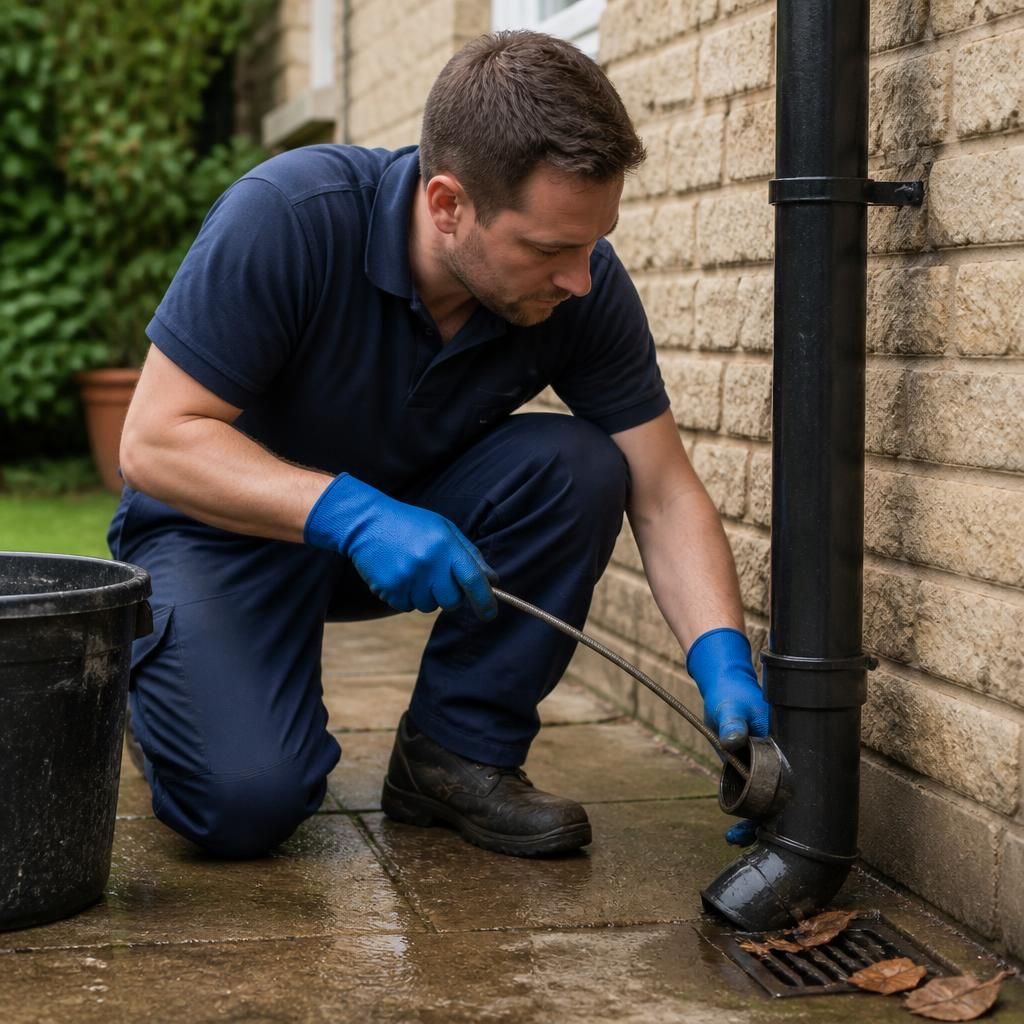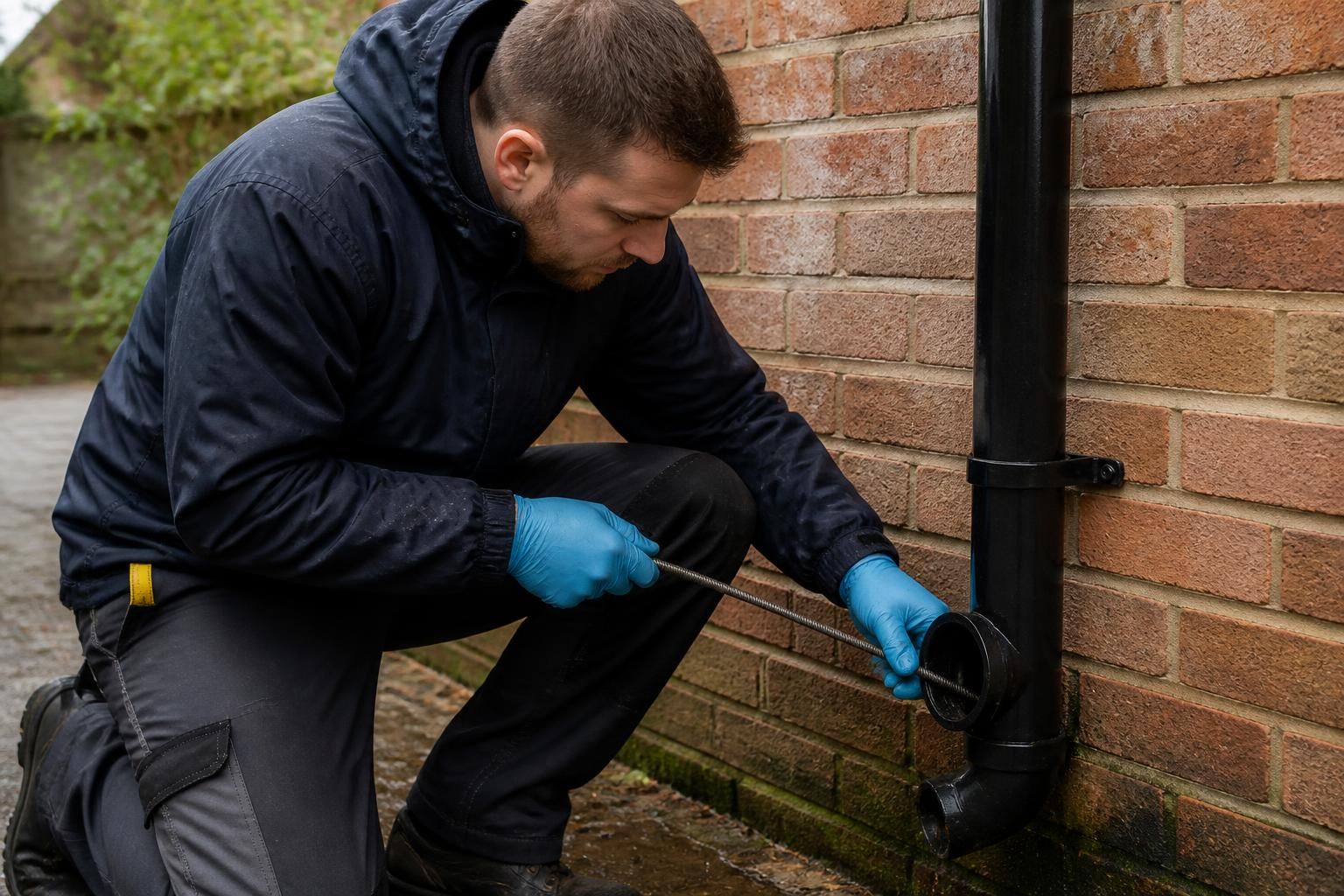
The least disruptive approach is usually to work through an existing opening rather than dismantling the gutter. A plumber may use the downpipe outlet, an accessible shoe, a hopper, a rodding point or an inspection opening, depending on where the obstruction has formed and how the pipe is configured.
Common methods include:
- Access from the top: Debris near the outlet or upper section can sometimes be loosened with a suitable rod, flexible cleaning tool or controlled flow of water. Care is needed around the gutter outlet, as excessive force can split seals or push debris further into the pipe.
- Access from the bottom: Where the downpipe has a removable shoe or accessible connection, the lower section can be opened and cleared upwards. This can be useful when leaves, moss or compacted silt have collected near the base.
- Use of an inspection point: Some systems include a rodding eye or access cover. Clearing through this point avoids disturbing the gutter and can provide a better route to a blockage lower down.
- Controlled flushing: Water can help move loose material once a passage has been created. It should not be introduced at high pressure into a sealed or completely blocked pipe, because trapped water may force joints apart or escape into the building fabric.
The position and nature of the obstruction determine whether these methods are appropriate. Loose leaves and silt are generally easier to clear than hardened deposits, plant growth, nesting material or an object lodged across a joint. If the blockage is below ground, the problem may be in the drain connected to the downpipe rather than in the vertical pipe itself. In that situation, clearing the gutter outlet alone will not resolve the restriction.
When removal may be necessary
Removing part of the downpipe, rather than the gutter, may be required if the blockage cannot be reached through an existing opening or if the pipe has become misaligned. Gutter removal is more likely to be considered where the outlet is damaged, the obstruction is trapped behind a sealed connection, or the gutter itself has to be repaired or replaced. Dismantling should be a last resort when a suitable access point is available, because disturbing older joints can create leaks that were not present before.
Signs that the blockage needs careful investigation include water spilling over the gutter, a downpipe that remains full after rainfall, damp staining on walls, movement at pipe joints and repeated overflow after a previous clearance. Do not seal over a leaking joint or force a rigid rod through a pipe without identifying the obstruction first. A ladder should only be used on stable ground with appropriate precautions, and work at roof level may be unsuitable without proper equipment.
A professional assessment normally involves checking the gutter outlet, following the downpipe route, testing how water drains and inspecting accessible joints. This helps distinguish a blockage from a collapsed section, poor alignment or a defect in the connected underground drain. Ideal Plumbing Services provides plumbing and drainage support for residential customers in Birmingham and across the West Midlands, including assessment and repair where unblocking alone is not sufficient.