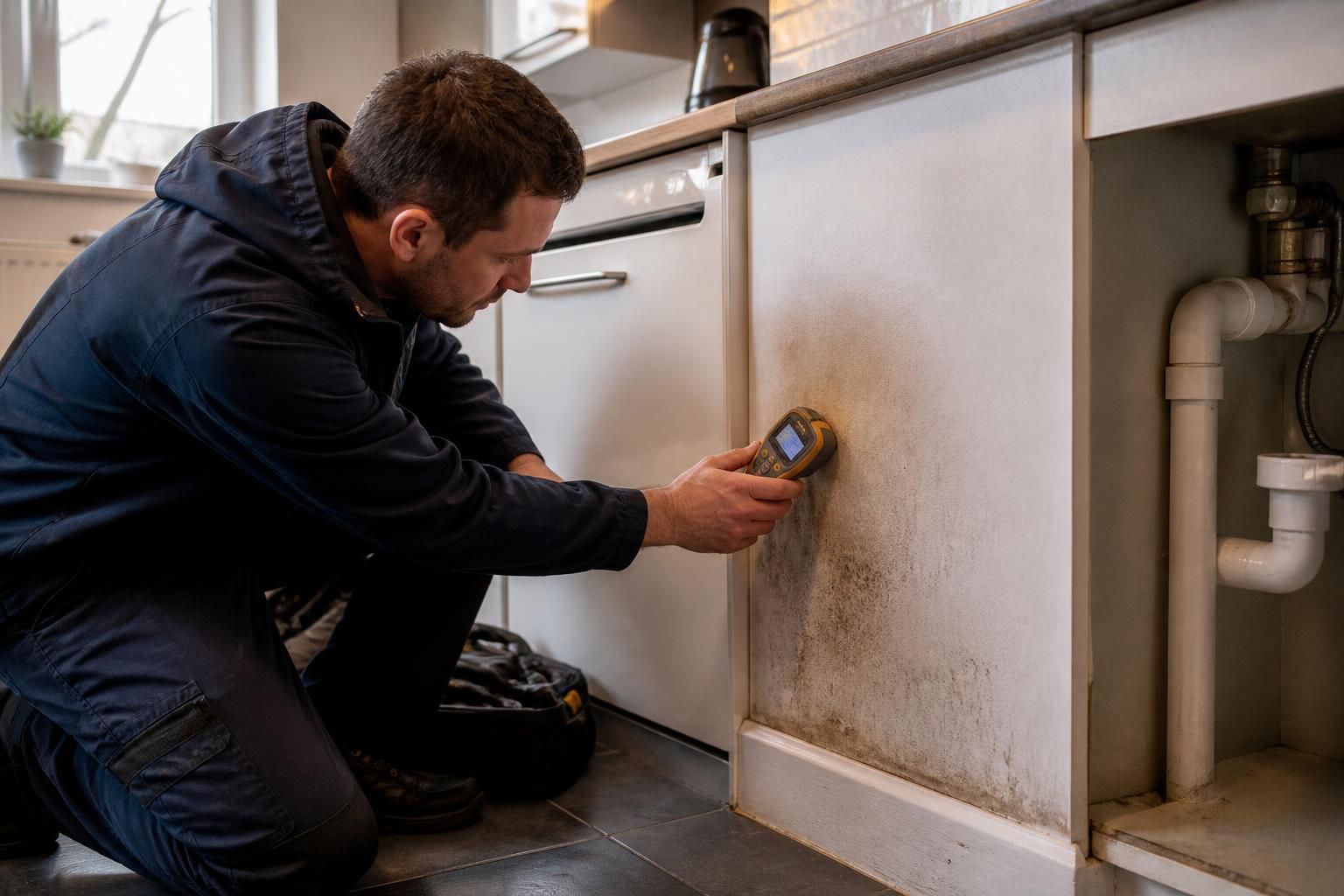
The suitability of domestic leak detection depends less on whether a property is a flat or rented and more on the leak’s location, the building’s pipework and who controls access to the affected area. Specialist detection can be used in many flats and rented homes to investigate hidden moisture without immediately removing large areas of flooring, walls or ceilings.
Flats can present additional tracing challenges because water may travel through floors, ceilings, service ducts and adjoining walls before staining becomes visible. The visible damage may therefore be some distance from the actual source. A leak detection assessment should consider:
- water supplies and waste pipes within the individual flat;
- pipework passing through walls, floors or ceiling voids;
- shared risers, communal heating systems or other building services;
- neighbouring flats above, below or beside the affected property; and
- whether condensation, rainwater penetration or a drainage fault could be mistaken for a plumbing leak.
In a block of flats, the person arranging the inspection should explain the symptoms as accurately as possible, including when dampness first appeared, whether it changes when taps or appliances are used, and whether the issue affects a particular room. Access may be needed to more than one property if the evidence suggests that water is crossing between flats. A leaseholder, landlord or managing agent may also need to authorise work involving communal areas or shared pipework.
Rented properties are also suitable for leak detection, but responsibility for investigation and repair should be clarified before work starts. Tenants should report the problem to the landlord or managing agent and follow the agreed access process. The person responsible for the property can then decide whether the inspection should cover the tenant’s accommodation, another part of the building or a shared installation. This helps prevent avoidable disputes about permission, damage and repair costs.
A typical investigation may begin with a visual inspection and moisture readings. Depending on the evidence, a technician may then use equipment such as acoustic listening devices, thermal imaging or tracer techniques to narrow down the source. These methods do not make every leak completely non-invasive, and the exact approach depends on the pipe material, access, background noise, temperature and the condition of the building. However, locating the likely source before opening a surface can make any necessary repair more targeted.
Detection is particularly useful where:
- there is a damp patch but no obvious damaged pipe;
- a ceiling or wall is becoming marked beneath a bathroom or kitchen;
- a heating or water system appears to be losing pressure;
- flooring is lifting or swelling without an obvious spill;
- a musty smell persists after a visible leak has been repaired; or
- water damage keeps returning in the same location.
Before an inspection, occupants should avoid covering the affected area with fresh paint or sealant, move belongings away from suspected dampness and record any changes with photographs. Do not remove fitted units, flooring or plaster solely to look for the leak unless this has been agreed with the responsible owner or agent. If water is close to electrical fittings, appliances or consumer units, keep clear of the area and arrange appropriate assistance.
The outcome of a detection visit should distinguish between the suspected source, the route water has taken and the visible damage. These are not always the same point. In a rented home or flat, this distinction can help the landlord, managing agent, freeholder or insurer decide what needs repairing and who should coordinate the next stage. Detection identifies the likely cause; drying, making good and related building repairs may require separate work.
Ideal Plumbing Services provides domestic leak detection for homeowners, landlords and tenants in Birmingham and across the wider West Midlands, including investigations where access, concealed pipework or neighbouring properties need careful consideration.