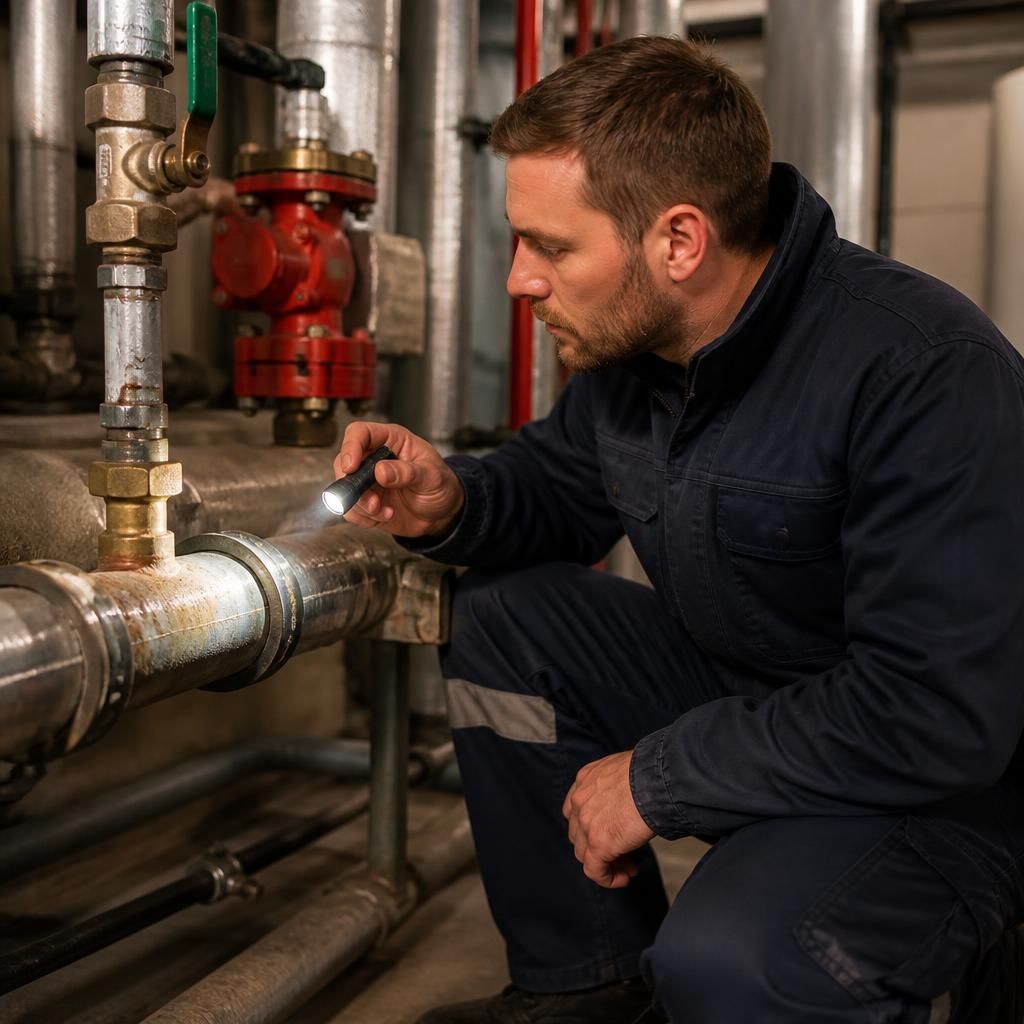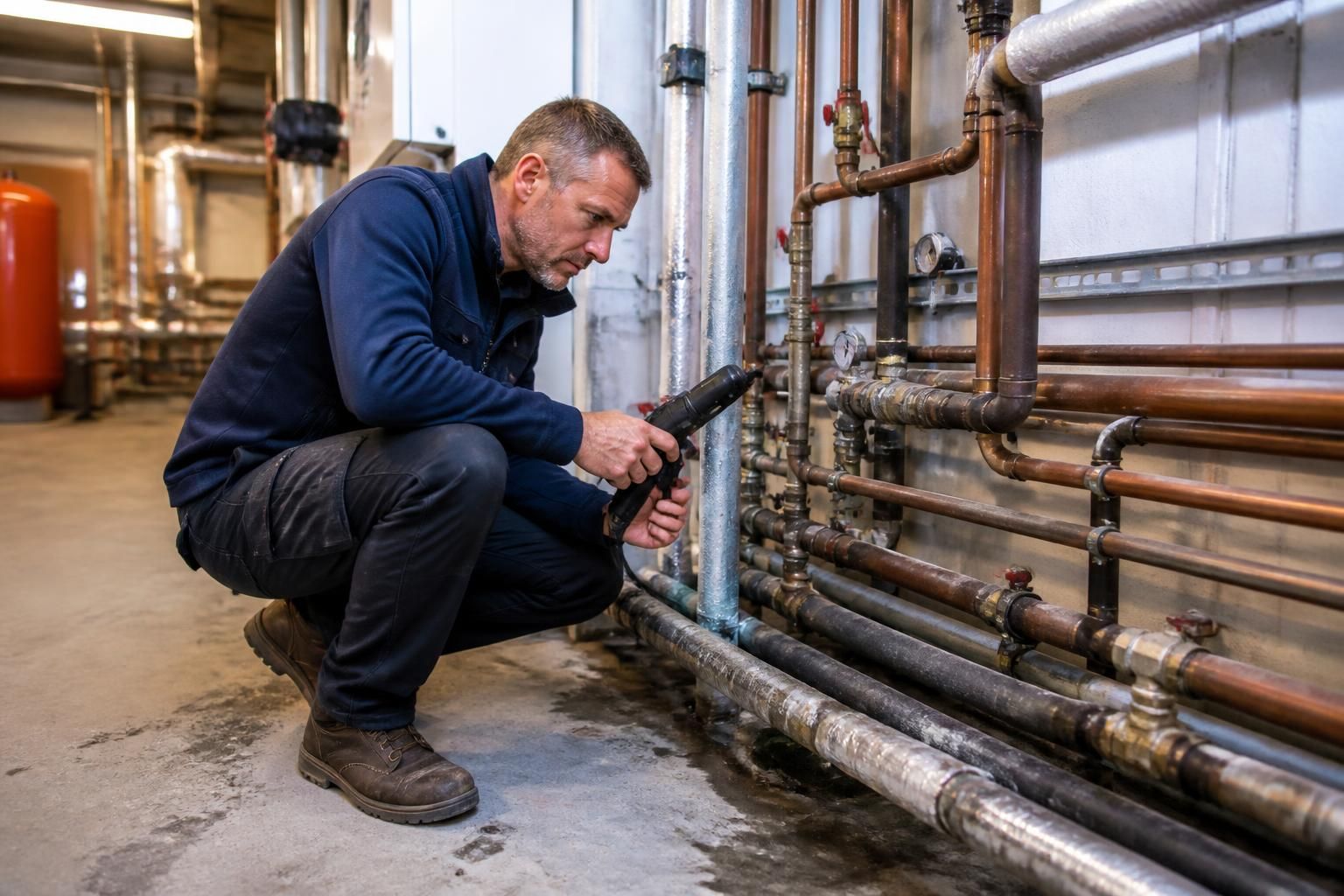
Prepare for commercial leak detection by appointing a responsible site contact, arranging safe and authorised entry, identifying relevant building controls, and informing the technician about operational restrictions. Good preparation helps the investigation take place safely and gives the technician the context needed to assess the plumbing or heating system without unnecessarily affecting the premises.
Nominate a site contact. Choose someone who understands the building and can make practical decisions during the visit. This person should be able to provide entry to relevant areas, explain how the premises are used, identify responsible contractors or facilities staff, and confirm which parts of the installation can be inspected. For managed buildings, agree in advance who can authorise isolation, testing or access to restricted plant areas.
Arrange permissions and security procedures. Commercial premises may require visitor registration, identification, a security briefing, signing-in procedures or an escort. Confirm these requirements before the appointment and make sure keys, fobs or access codes are available to the nominated contact. If the suspected leak is in a rented, shared or managed property, inform the landlord, managing agent, occupier or relevant maintenance team so that access is not delayed by uncertainty over responsibility.
Explain site-specific safety risks. Tell the technician about restricted areas, working-at-height requirements, confined spaces, asbestos-related controls, security-sensitive rooms and any other hazards that could affect the inspection. Do not ask anyone to enter a hazardous area or disturb building materials simply to investigate a leak. If water is close to electrical equipment, isolate the affected area only where this can be done safely and through the appropriate responsible person. Keep staff and visitors away from unsafe surfaces, exposed services or areas where ceilings and fittings may have been affected.
Understand the building’s water and heating controls. Before the visit, establish who is authorised to operate stop taps, isolation valves, boilers, pumps, tanks, boosted water systems or other relevant plant. The technician may need to understand how the system is divided into zones, but isolation should only be carried out when it is safe and does not create a greater risk. Consider the consequences for occupants, sanitary facilities, fire protection, heating, production processes and any other essential operation before changing system settings.
Plan around the premises’ use. Consider which activities could be affected by inspection equipment, temporary isolation or access to service areas. In offices, retail premises, schools, healthcare settings, hospitality venues and managed residential blocks, coordinate with occupants and facilities staff so the investigation does not conflict with customer areas, patient or resident needs, deliveries, examinations, food preparation or other controlled activities. Where several parties share the building, establish who needs to be informed before any system is tested.
Protect sensitive contents and equipment. Move vulnerable stock, paperwork or portable electrical items away from areas where further water may be released during testing, provided this can be done without entering an unsafe area. Use suitable protection for flooring and furnishings where appropriate, and identify equipment that must not be switched off or exposed to moisture. This preparation is particularly important in plant rooms, server areas, storage spaces and premises containing specialist machinery.
Prepare relevant operational information. In addition to the physical inspection, it can help to provide the names of facilities contractors, details of recent alterations to the building and information about any planned shutdowns or maintenance work. If the property has separate water supplies or multiple occupiers, explain how responsibility is divided between units. This can help distinguish a defect within the commercial premises from an issue affecting a shared service or neighbouring area.
Keep the investigation area undisturbed. Avoid covering, sealing, repainting or carrying out temporary alterations around suspected damage before the inspection, unless this is necessary to make the area safe. Preserve any visible evidence where possible, while preventing access to unsafe areas. If an emergency measure has already been taken, record what was done and tell the technician, including any valve closures, temporary repairs or changes to equipment settings.
After the inspection, ask for the findings to be explained in practical terms. A useful report should distinguish the suspected source from secondary damage, identify any limitations in the investigation and state whether further access, testing or repair is recommended. Commercial leak detection identifies the location and likely cause of water loss; the appropriate repair, reinstatement and responsibility for associated damage may need to be agreed separately with the owner, occupier, insurer or maintenance provider.