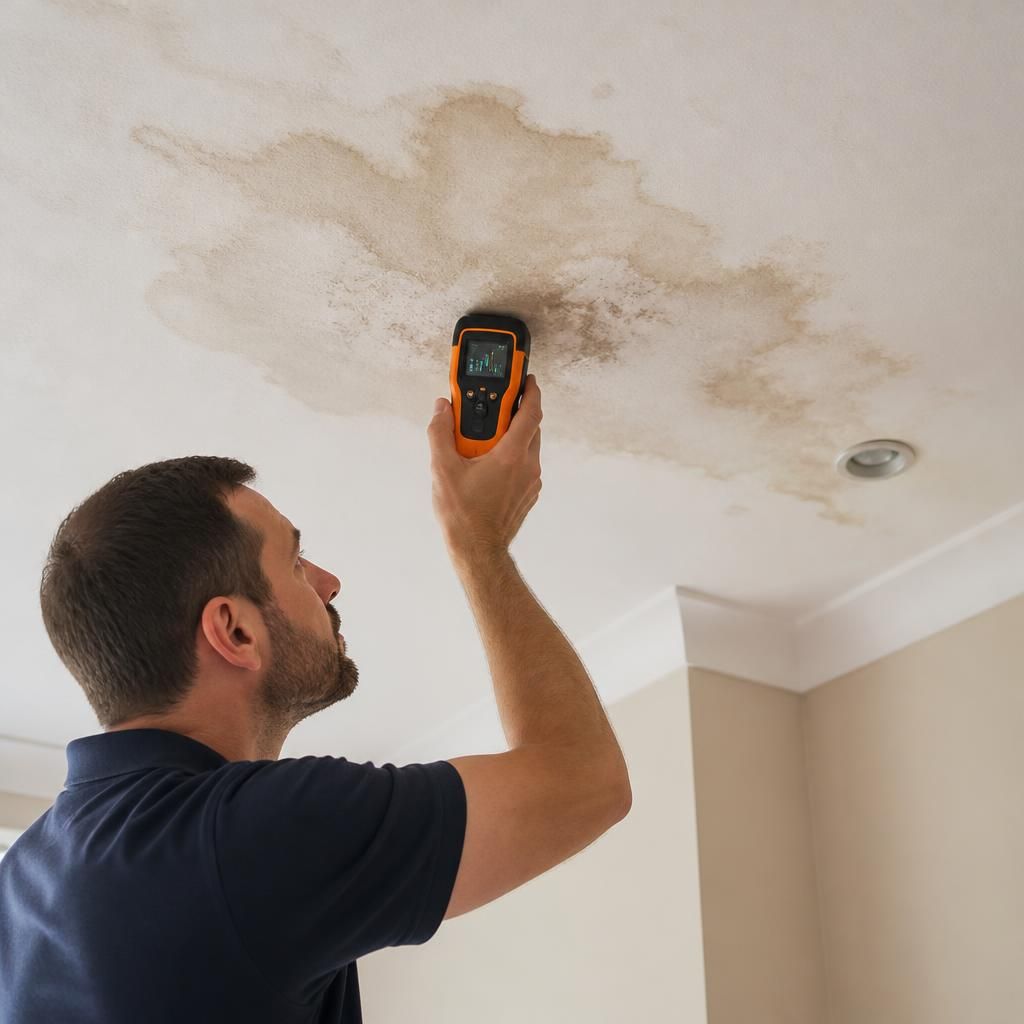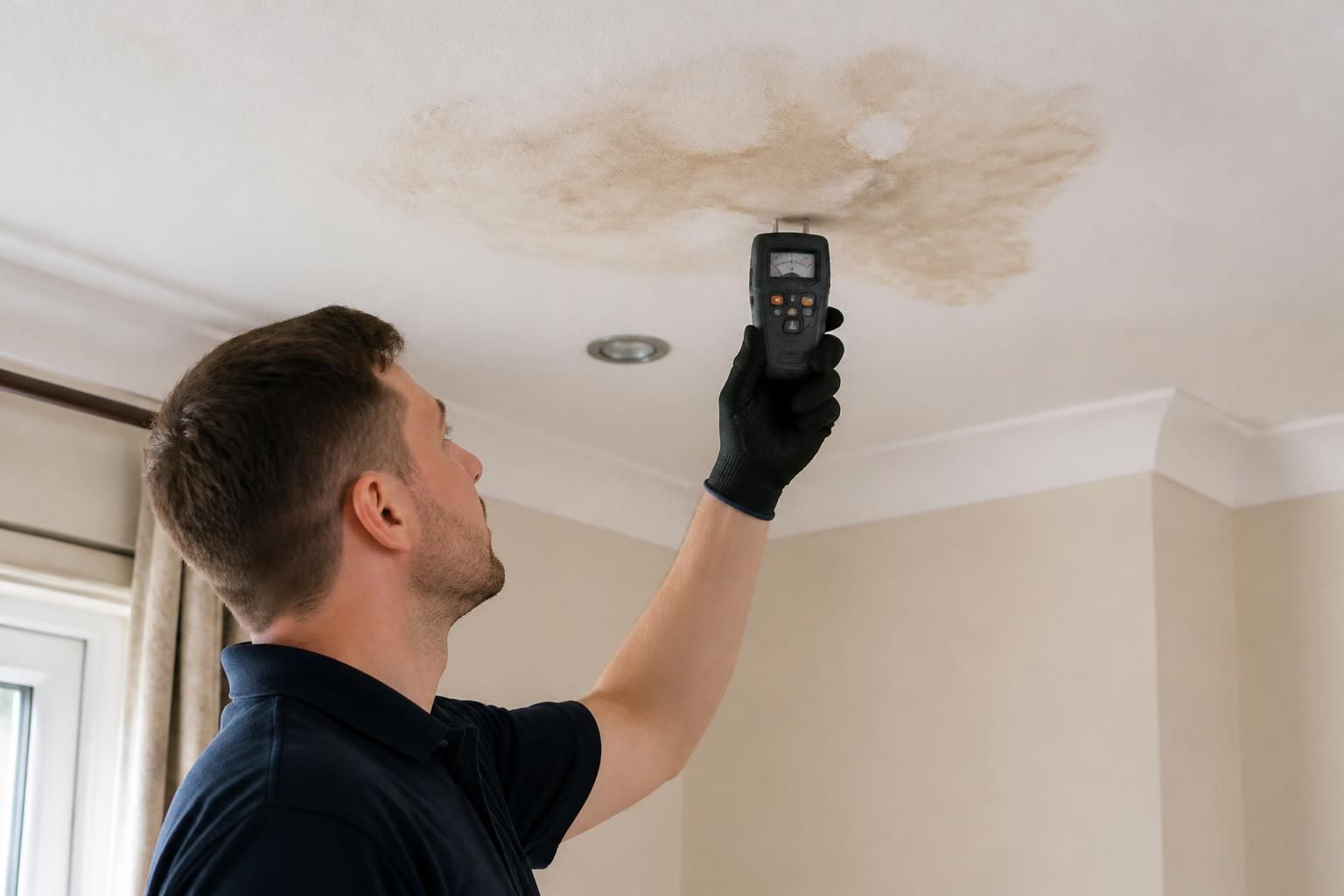
In many cases, a ceiling leak can be traced while the plaster remains intact. The aim is to identify the wet area, follow the likely path of the water and distinguish the active source from older staining. This can usually be done by combining several observations rather than relying on a single test.
Moisture mapping involves taking readings at multiple points across the ceiling and nearby walls. Comparing readings helps reveal whether moisture is concentrated around one area or has travelled from elsewhere. Water does not always appear directly below the failed pipe, roof covering, bathroom fitting or appliance, because it can run along joists, plasterboard, insulation or other structural surfaces before becoming visible.
Readings are compared with relatively dry areas and interpreted alongside the ceiling’s materials. Plaster, plasterboard, timber and insulation retain moisture differently, so a reading is not by itself proof of a leaking pipe. A competent inspection considers the pattern, depth and distribution of moisture, as well as whether the area is drying or becoming wetter.
Thermal imaging can highlight temperature differences associated with damp materials, evaporating water or concealed pipework. It is particularly useful for scanning a wider ceiling and locating an area that deserves closer examination. Thermal images show temperature patterns rather than water directly, so they need to be checked against moisture readings and the construction of the building. Cold spots caused by insulation gaps, draughts or normal variations can otherwise be mistaken for damp.
Acoustic investigation may help when a pressurised water pipe is leaking behind the ceiling. Specialist equipment can detect the sound or vibration produced by escaping water, allowing the suspected route to be narrowed down without removing a large section of plaster. This approach is less useful where the leak is very small, intermittent, close to loud equipment or associated with a waste pipe that only carries water when a fixture is used.
A survey will also consider the circumstances surrounding the stain. Useful details include:
- whether the mark becomes worse after using a bathroom, toilet, washing machine or heating system;
- whether it appears after rainfall rather than after using indoor plumbing;
- whether the ceiling feels soft, swollen or unusually cold;
- whether paint is blistering, plaster is cracking or a musty smell is present;
- whether the stain is expanding, drying out or changing position.
These clues can help separate different causes. A leak from a supply pipe may continue even when no taps or appliances are being used. A waste-pipe leak may appear only when water is discharged above. A roof defect is more likely to be linked to wet weather, while condensation tends to produce broader, recurring dampness in poorly ventilated areas rather than a sharply defined wet path.
Non-invasive detection has limits. A ceiling with thick insulation, several layers of plaster, extensive previous water damage or difficult access may conceal the clearest evidence. Water can also remain trapped after the original fault has been repaired, making it important to establish whether the source is still active. Where readings and other observations cannot provide enough certainty, a small inspection opening may be recommended instead of removing large areas of plaster unnecessarily. The location should be chosen to provide useful access while keeping later making-good work limited.
Before any inspection or repair, electrical safety should be considered. Water near light fittings, cables or electrical equipment can create a serious hazard. If a ceiling is sagging, water is close to electrics, or a substantial flow is present, avoid touching wet fittings and isolate the relevant supply only if it can be done safely. Containers can limit damage from dripping, but they do not resolve the source.
Once the likely origin has been identified, the next step is to inspect the relevant pipework, fittings, roof area or adjoining room and confirm the fault before carrying out a repair. The affected ceiling may need time to dry afterwards. Repainting or patching too soon can trap moisture and conceal continuing dampness, so the surface should be checked again before decorative repairs are completed.